How it works
The collector records agent activity on each laptop. The server rebuilds each session into turns, scores it in three layers and shows the evidence in the dashboard.
Developer laptop
- Coding agent (Claude Code, Codex, ...)
- attestyx collector
- recording proxy (pass-through)
- session-file reader
- bypass detection
- skills / MCP policy
Attestyx server (self-hosted)
- API: ingest, enrolment, policy
- Worker, per session:
- rules, one step at a time
- case board, links steps into trails
- model clues, Guard 32M + injection detector
- PostgreSQL and the dashboard
1. Collect
The attestyx collector runs on each laptop as a single ~10 MB binary with no runtime to install.
- A pass-through proxy (
127.0.0.1:8790) records model traffic without changing what the developer sends. It stores a copy of each request and response, extracts the prompt, reply, tool calls and the loaded tools, MCP servers and skills, and redacts credentials. - A session reader tails the transcripts each agent already writes to disk, normalises them into one event format, and spots sessions that never went through the proxy (bypass).
- The collector sends events to the server over HTTPS and downloads the skills, plugins and MCP policy.
Details: Laptop collector.
2. Score
Turns
The server rebuilds each session into turns. A turn is one developer message and everything the agent did in response. Severity is given per turn and per session.
Layer 1: rules
Structural checks on commands, file edits, URLs, MCP calls and tool output, one step at a time. Examples: a read of .env, a curl … | sh, a force-push to main, a new MCP server in an agent's settings. The full list is in the rule reference.
Layer 2: case board and trails
The case board follows secrets, files and instructions across steps and turns, and turns linked steps into trails:
- read → copy → encode → send: a secret read in one step, encoded in the next and posted in a later turn is one trail, rated CRITICAL.
- "instruction in a README" → "agent did it": when the agent acts on an instruction found in content, the trail links the instruction to the action, rated CRITICAL.
- Other trails: a secret file added to git and then pushed; a downloaded program then run; a database dump sent to another host; uncommitted work thrown away without the developer asking.
Layer 3: model clues
Two small classifiers add evidence the rules miss:
- Attestyx Guard 32M scores each step for risky actions.
- Wolf Defender detects prompt injection in tool output and fetched content.
A model clue alone never raises a session above MEDIUM, and no model ever lowers a severity. See Models.
Re-scoring
After a rule changes, maintainers bump RULES_VERSION in server/app/risk.py. The worker then re-scores every stored session with the new rules.
3. Review
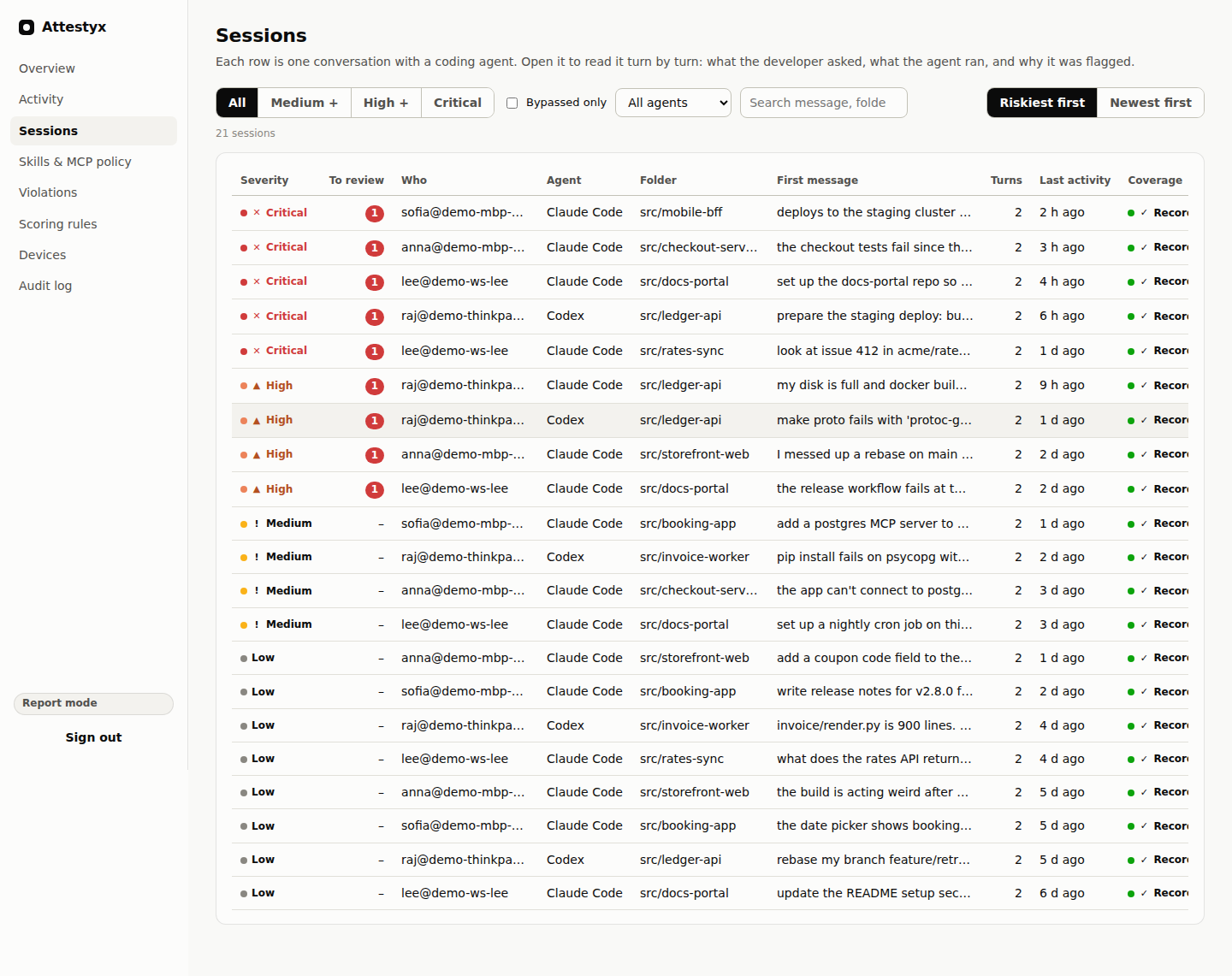
The dashboard lists flagged sessions by severity and shows the evidence for each turn: the rule that fired, the exact command or output (secrets masked), and the chain of steps behind it.
- Confirm threats that need follow-up.
- Mark false positives.
- Correct the model when a clue is wrong.
The dashboard has pages for Overview, Activity, Sessions, Skills & MCP policy, Violations, Scoring rules, Devices and the Audit log. Every admin action is in the audit log.